
When higher output begins to reveal inconsistent solder joints or rising defect rates, robotic soldering becomes the right automation strategy when a soldering process can no longer be stabilized through manual control. In most cases, the shift is not driven by a simple preference for automation. Instead, it typically follows persistent yield variation, or tighter reliability requirements.
For example, in advanced manufacturing environments such as automotive electronics, medical device assemblies, and high-density PCB production, consistent solder joints must be achieved through controlled equipment rather than relying on operator technique. In these situations, manufacturers adopt robotic soldering to maintain consistent joint quality and process stability.
Understanding when robotic soldering is the right path requires honest assessment of your process, output targets, and quality requirements.
When Manual Soldering Starts to Fall Short
Manual soldering introduces natural variability in thermal input, deposition timing, contact duration, and joint positioning. Even experienced operators cannot reproduce identical thermal and mechanical conditions across thousands of cycles.
Over time, this variability appears as inconsistent fillet geometry, uneven wetting, and irregular intermetallic growth. These effects often become visible in statistical process control data through drift, increased rework, or declining yield.
Robotic soldering becomes necessary when operator adjustments and additional training no longer restore stable process performance. Robotic soldering systems replace operator-dependent variables with programmed motion paths, synchronized solder delivery, and precision soldering heads with closed-loop temperature control. As a result, the soldering operation shifts from operator-dependent results to stable, repeatable production.
Narrow Thermal Windows and Energy Control
Some assemblies operate within very strict thermal limits. High-density PCB layouts, mixed thermal mass joints, and temperature-sensitive components require precise control of heat transfer and dwell time.
Under these conditions, the soldering process must operate within a narrow thermal window. Excess heat can damage nearby components or accelerate brittle intermetallic growth. Insufficient heat prevents proper wetting and weakens the joint.
Robotic soldering controls heat delivery through closed-loop temperature feedback and programmable dwell timing. Energy is applied consistently from joint to joint, independent of operator fatigue or technique.
When product reliability depends on maintaining a defined thermal profile, robotic soldering provides the level of control needed for stable production.

As production volumes grow, manual soldering often becomes the limiting factor in maintaining consistent throughput. Cycle time variation, operator fatigue, and shift-to-shift differences can introduce quality fluctuations that increase with output.
Robotic soldering maintains stable cycle times, synchronized solder delivery, and repeatable motion accuracy across long production runs.
Production volume alone does not determine when automation should be implemented. In many cases, the transition occurs when higher output begins to reveal inconsistent solder joints or rising defect rates that training or supervision can no longer correct.
When this happens, robotic soldering helps stabilize both throughput and yield.
Geometric Precision and Access Constraints
Modern electronic assemblies continue to become smaller and more complex. As component density increases, joint access geometry becomes more constrained.
Fine-pitch components and multi-axis solder paths require consistent approach angles and precise positional control. Manual execution in these conditions increases the risk of misalignment, insufficient contact, or disturbance of nearby components.
Robotic soldering systems provide repeatable positioning accuracy and programmable motion paths that maintain consistent joint formation even in restricted spaces.
When positional tolerance becomes a limiting factor, robotic motion control helps reduce defect risk.
Uptime and Production Risk Management
Production environments with high uptime requirements cannot tolerate frequent interruptions caused by rework, operator variability, or inconsistent process control. In manual soldering operations, uptime is often limited by operator fatigue, skill variation, and the need for regular supervision. These factors can introduce unplanned pauses, increased defect rates, and inconsistent throughput across production.
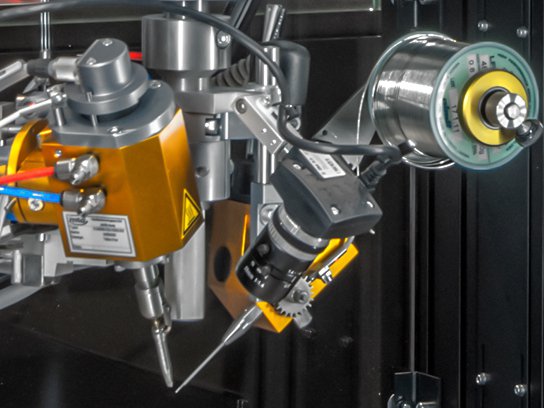
Robotic soldering systems reduce these risks by stabilizing the process and minimizing reliance on manual input. Platforms such as the TR300 tabletop soldering robot from mta robotics are designed to maintain continuous operation with consistent motion paths, controlled heat input, and synchronized material delivery. By reducing variability, robotic systems help limit rework cycles and prevent process drift that would otherwise interrupt production flow.
Compared to both manual soldering and less specialized automation, well-engineered robotic systems support higher effective uptime by maintaining stable operating conditions over extended runs. This allows manufacturers to achieve more predictable throughput, reduce unplanned downtime, and better manage production risk in high-volume environments.
Engineering Criteria for Implementation
Robotic soldering becomes justified when measurable indicators demonstrate that manual control cannot maintain defined process thresholds. Typical indicators include:
- Persistent yield instability or declining Cp/Cpk values
- Inability to maintain narrow thermal process windows
- Increased rework rates tied to operator-dependent variability
- Inconsistent fillet geometry across production shifts
Automation should be implemented when it resolves clearly defined process limitations. When variability is the dominant failure mechanism, robotic soldering functions as a controlled manufacturing process rather than a productivity improvement.
Maintaining Stable Soldering Processes
The decision to implement robotic soldering should be based on one question: can the soldering process consistently remain within defined performance limits without engineered control?
If not, robotic soldering provides deterministic thermal regulation, synchronized deposition, repeatable motion accuracy, and measurable validation. In advanced manufacturing, automation is a response to process instability, not a preference.
mta robotics designs robotic soldering systems and precision soldering heads specifically to control these variables. When repeatability and long-term stability are required, robotic soldering becomes the appropriate implementation strategy.