
Automated manufacturing lines rely heavily on two-component materials for critical sealing, potting, and bonding applications. To ensure optimal results, epoxy dispensing systems must achieve consistent, homogeneous blending immediately before application. For process and production engineers, selecting the ideal fluid system requires balancing material behavior, cycle times, and equipment complexity.
Setting up a two-component dispensing process requires choosing between passive static systems and active dynamic platforms. This article explores both volumetric fluid methods. We break down their operational mechanics, structural limitations, and maintenance realities. Ultimately, this guide will help you determine the most reliable configuration for your specific factory floor application.
Understanding Static Mixing: The Cost-Effective Baseline
Static mixing remains a fundamental approach for multi-component epoxy dispensing due to its mechanical simplicity. The system utilizes a single-use plastic nozzle equipped with internal geometric elements. Pumps push the separated material streams through this tube. The geometric elements then passively divide and recombine them into a uniform blend.
This passive methodology is highly effective when your manufacturing parameters naturally align with the fluid chemistry. Static configurations fit best under specific operational baselines:
- The required shot sizes are large enough to rapidly flush the mixer's internal volume
- The material's pot life significantly exceeds the duration of a standard process cycle
- The production line prioritizes mechanical simplicity and minimal initial investment
Passive blending faces one primary constraint: residence time. This measures how long the blended fluid remains stagnant inside the nozzle. If a cycle takes longer than anticipated, highly reactive materials will begin cross-linking mid-process. As viscosity spikes inside the tube, internal back pressure scales exponentially and degrades volumetric flow consistency.
Modern assembly lines frequently require handling extreme fluid viscosities up to 500,000 mPas or achieving micro-dispensing volumes down to 1 nL. When you reduce shot sizes to these microscopic levels, there is insufficient volume moving through the system to adequately flush out the aging material. Ultimately, executing precision 2K dispensing with highly reactive fluids pushes passive static systems beyond their operational limits.
Understanding Dynamic Mixing: Active Homogeneity for Demanding Applications
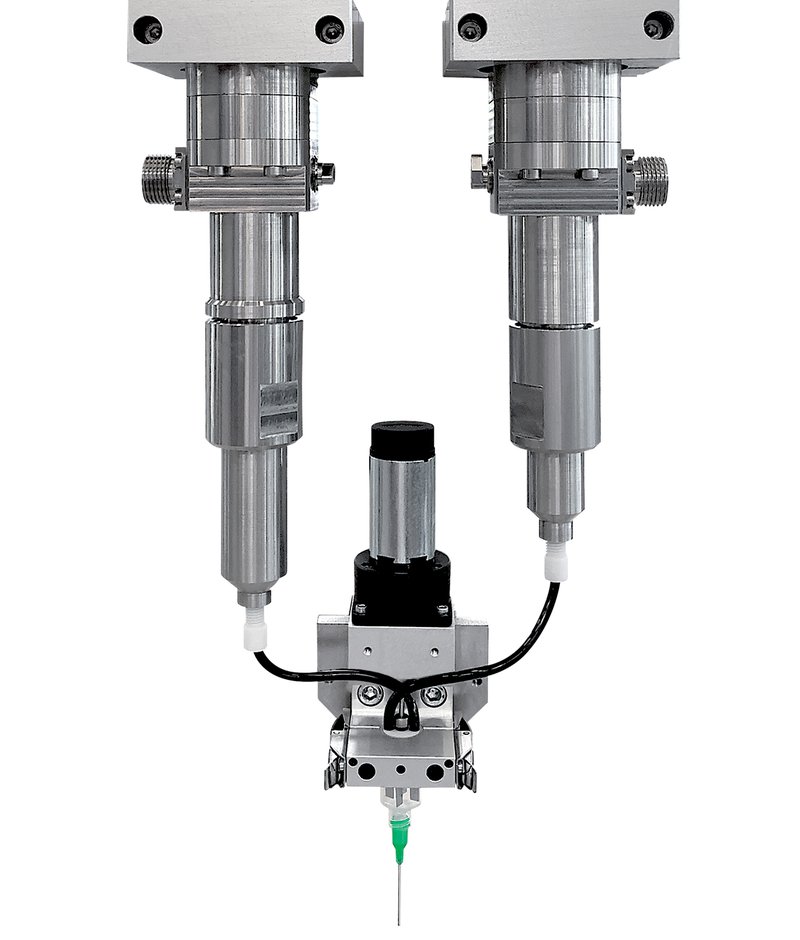
To overcome the limitations of passive flow, dynamic systems introduce an active motorized component directly into the fluid path to handle complex epoxy dispensing challenges. Instead of relying on fluid pressure alone, independent pumps feed the components into a reusable mechanical chamber. Inside this space, a motor-driven impeller actively shears and blends the fluids immediately prior to application.
The core engineering advantage of this active architecture is its extremely minimal mixed volume. The chamber design ensures the bulk of the material remains unmixed and safely separated until the exact moment of demand. The system blends only a minute fluid fraction at a time, which protects reactive material pot life and prevents premature curing.
If more time is needed between shots for work breaks, lunch, overnight, weekends, etc., there are several options to prevent the material from curing in the chamber. For short breaks, the head can purge material at regular intervals. For longer breaks, the chamber can be flooded with a single component to reduce cross-linking. If the machine will be idle longer, the mixing chamber can be removed and cleaned. All three options are typically used and selected based on the downtime relative to the material’s pot life.
Active blending platforms excel when process constraints make static flushing impossible during multi-component dispensing. Dynamic systems are engineered specifically for demanding production environments:
- Processing highly reactive materials where minimal mixed volume is required to prevent rapid curing
- Executing micro-dispensing applications where tiny shot sizes cannot adequately flush a static tube
- Accommodating extended cycle times that would typically cause stagnant fluids to cross-link
- Requiring strict digital programmability over rotational speeds and mixing ratios for sensitive fluids
However, this advanced capability introduces specific operational requirements. Because the mixing chamber is a permanent mechanical fixture rather than a disposable plastic tube, it necessitates automated cleaning cycles to prevent internal curing. Dynamic mixing chambers are designed for small shot sizes. When high flow rates are required, they cannot mix high volumes quickly. Additionally, the motorized drives and specialized seals represent a higher initial capital investment and require routine preventative maintenance to ensure continuous uptime.
Decision Matrix: Which One Should You Choose for Epoxy Dispensing
Choosing the ideal system for epoxy dispensing requires balancing your material chemistry against strict production goals. While passive static tubes offer straightforward operation and low initial costs, active motorized platforms deliver the absolute precision needed for highly reactive fluids. Ultimately, there is no universal solution, only the right engineering fit for your specific assembly line.
Navigating this choice means process engineers must carefully weigh their application constraints against the mechanical realities of both technologies. You have to consider long-term consumable footprints, maintenance capabilities, and how sensitive your fluid is to varying cycle times.
Engineers can use the following evaluation matrix to quickly benchmark their two-component dispensing requirements and identify the most reliable volumetric blending methodology.
| Parameter | Static Mixing | Dynamic Mixing |
|---|---|---|
| System Complexity | Low (No moving parts) | Moderate (Motorized drive) |
| Consumable Footprint | High (Disposable plastic nozzles) | Low (Reusable mechanical chamber) |
| Pot Life Sensitivity | High (Prone to nozzle clogging) | Low (Blended on-demand) |
| Flow Rate Suitability | Medium to Large | Micro-dispensing to Medium |
| Back Pressure Stability | Degrades as viscosity shifts | Exceptionally stable over long runs |
| Process Control Parameters | Limited (Fixed by geometry) | High (Programmable RPM and cycles) |
Process Validation: Engineering Your Proof of Process
Investing in capital equipment for epoxy dispensing, be it two-component dispensing or multi-component dispensing, requires eliminating all variables before a system arrives on your factory floor. Companies like mta robotics designs and builds both passive and active volumetric platforms. At mta robotics, our primary goal is finding the exact technical fit for your application rather than pushing a specific product line.
To secure your production investment and eliminate quality risks, highly qualified process development engineers utilize in-house laboratory testing to analyze your specific production fluids. We run extensive cycle tests to document precise material behaviors, volumetric repeatability, and internal pressure thresholds. This transparent evaluation concludes with a formal proof of process that guarantees your manufacturing results.
There is no need to guess which mixing technology will truly optimize your production line. Contact us at mta robotics today to discuss your project requirements and review your material data sheets. Secure your manufacturing efficiency by scheduling a comprehensive laboratory validation for your specific assembly process.