
Maintaining consistent solder joints on high-density assemblies sits at the heart of the robotic soldering process. Heat fluctuations can cause structural defects or permanent thermal shock to nearby sensitive components. Densely packed boards make the problem worse, since neighboring parts tolerate very little stray heat. Strict thermal settings enable robotic systems to protect these vulnerable areas.
Effective heat management supplies the exact energy a joint needs while holding the tip temperature stable. A balanced approach prevents the assembly from losing too much heat and guards against overexposure. The result is a repeatable joint that consistently meets electrical and mechanical requirements. Reliable temperature behavior, more than raw power, defines a dependable soldering process.
Importance of Precise Thermal Control in the Soldering Process
Every solder joint in advanced manufacturing depends on accurate heat for mechanical and electrical durability. An imprecise thermal profile compromises the reliability of the entire connection. The joint may look acceptable yet fail under load or over time. Strict heat management, therefore, serves several goals at once during the soldering process.
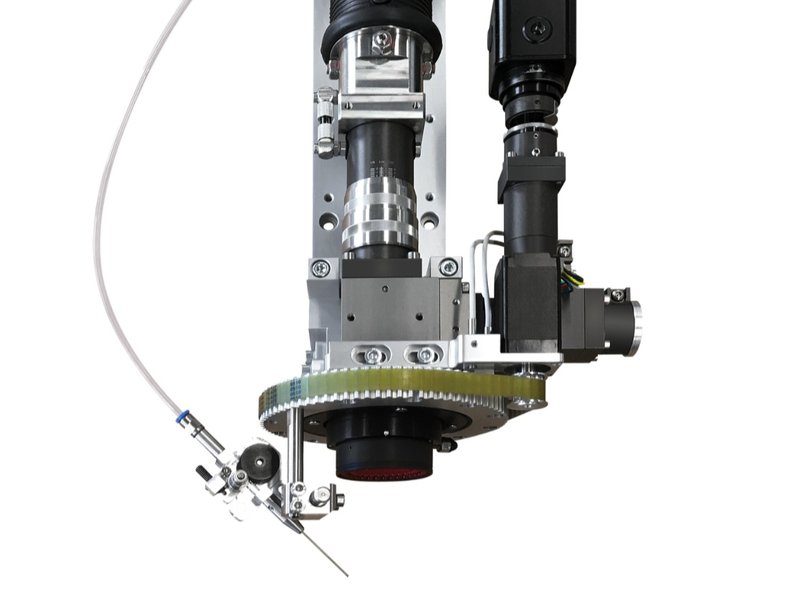
A joint forms correctly only inside a narrow temperature window, and several outcomes hinge on holding it.
- Fewer joint defects – Correct temperature melts the alloy fully and promotes wetting, so the solder flows and coats the connection evenly.
- Reliable flux activation – Controlled heat activates the flux at the right moment to clear oxidation, rather than burning it off early and leaving film impurities.
- Protected substrates – A tight heat window spares delicate base materials and nearby components from warping, delamination, or internal cracking.
- Counter to heat loss – Dense assemblies pull warmth away like heat sinks, so the system must inject exactly enough energy to compensate.
- Higher throughput – Faster tip recovery between joints reduces cycle downtime and keeps output steady across long shifts.
Each goal traces back to the same principle, which is delivering a known quantity of heat at a known moment. The alloy, the flux, and the substrate all respond to temperature on their own timelines. A system that respects all three timelines produces joints that pass inspection consistently. Missing any one of them undermines the connection, regardless of how the others perform.
How Robotic Soldering Systems Achieve Thermal Precision
Holding thermal equilibrium demands a system architecture built for rapid feedback. Robotic soldering systems adjust heat delivery at the exact millisecond of contact with the joint. Real-time response keeps every connection uniform across the entire soldering process. The hardware, not the operator, carries the burden of consistency.
Several engineered features work together to ensure precise and stable iron temperatures.
- Closed-loop regulation – A continuous feedback loop drives power adjustments to hold a tight variance, with classic iron heads regulating over a 4-20mA current loop to within ±5°C.
- High-accuracy heads – The MSH150 iron head holds temperature to ±2°C after stabilization for demanding work.
- Embedded sensing – Thermal sensors sit deep within the heating element at the tip, reading the actual tip temperature right at the joint site.
- Instant compensation – When the tip meets a cold component, the loop raises power immediately, then throttles back once the solder melts to prevent overshoot.
A key feature that mta robotics employs is analog power output. The power to the heating element increases proportionally to the temperature demand. When the temperature drifts slightly, a little power is added to bring it back. Soldering joints with high thermal mass draw more power as needed. Output gradually decreases as the actual temperature approaches the desired temperature. The result is a more stable temperature than digital controllers can hold, since digital systems cycle on and off at full power.
Induction and laser heads pursue the same stability through different physics. Induction delivers energy directly into the joint, while laser heads apply tightly focused, non-contact heat for the smallest points. Both integrate into the same robotic platforms and obey the same closed-loop discipline. The chosen technology follows the joint geometry, yet the commitment to regulated heat stays constant.
A further mechanical detail protects the joint during contact soldering. A pneumatically dampened spring lowers the tip gently onto the part rather than striking it. The compliance ensures clean thermal transfer without damaging board surfaces or misaligning the head. Stable contact and stable temperature together give the joint its best chance to form correctly.
Achieving Soldering Process Reliability for High-Specification Industries
Regulated sectors leave no margin for defective joints in the finished product. Production lines must hold a stable, repeatable environment across long manufacturing runs. Predictability of that order rests on controlling the core variables of the soldering process. Temperature stands first among those variables in nearly every case.

Specialized robotic execution earns its place in these industries for several reasons.
- Identical cycles at scale – Robotic systems replicate the same thermal profile across hundreds of thousands of cycles, matching the quality of bulk surface-mount processing.
- Real-time monitoring – The system watches thermal feedback continuously during production, keeping the process from drifting outside engineering limits.
- Less rework – Removing temperature swings cuts cold joints and substrate damage, which lifts yield and uptime for automotive and medical manufacturers.
- Turnkey synchronization – Integrating these heads into fully customized robotic cells aligns axis motion with heat delivery for a production-ready result.
Automotive and medical work illustrate the stakes plainly. A pressure sensor or an implant component cannot ship with a marginal joint, since field failure carries real consequences. Repeatable thermal behavior lets a manufacturer prove that every joint met the same standard. Process reliability becomes a documented property of the line rather than a hope.
Engineering Out the Variance in Your Soldering Process
Mastering thermal dynamics is a foundational requirement for high-yield manufacturing. Removing unpredictable heat variables protects quality at every stage of the soldering process. The alloy melts cleanly, the flux activates on cue, and the substrate survives untouched. A regulated thermal profile turns a difficult joint into a routine one.
The right approach depends on the joint, the board, and the production target, which a specification sheet alone rarely resolves. mta robotics delivers this precision through specialized soldering heads and fully integrated soldering robots, backed by laboratory process validation. The team confirms the thermal profile on your actual parts before any commitment. Contact us at mta robotics today to integrate advanced thermal control into your production line and secure unmatched operational efficiency.