
Microdispensing of natural rubber was long considered impractical, despite the material's exceptional properties. Natural rubber offers a rare mix of elasticity, tensile strength, and mechanical resilience. The elastomer stretches up to 800 percent and recovers its shape without lasting damage. Refined from the milky sap of the rubber tree, it serves countless industrial roles.
Bulk applications use the material freely at high volumes. Tires, latex gloves, and elastic fibers all depend on its mechanical strengths. Small-volume work historically failed because the material hardens quickly during handling. Contactless jetting now removes the barrier and brings natural rubber into precise production.
The Challenges of Microdispensing Natural Rubber
Natural rubber earns its reputation for toughness in finished parts. The same material becomes difficult the moment a line attempts small doses. Behavior during handling, not chemistry on the part, creates the trouble. Several distinct problems appear once production moves below bulk volumes.
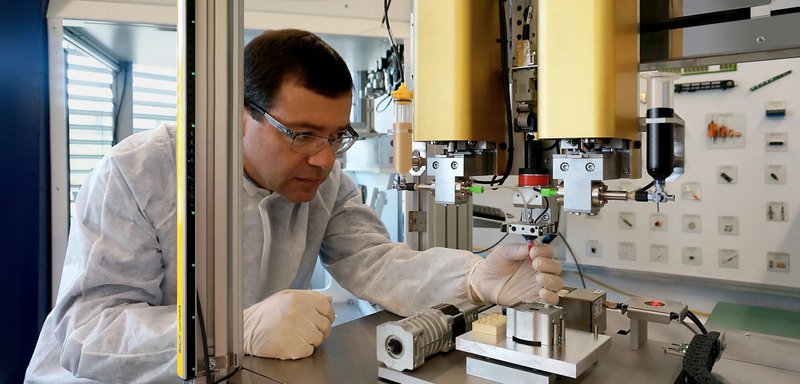
Reaction time sits at the center of every microdispensing issue. Natural rubber changes viscosity fast, and a brief pause hardens it in place. The hardening begins during conveying to the dispenser itself. It grows worse at any standstill, however short the interruption. Conventional contact methods cannot keep pace with such speed.
- Premature hardening – The material stiffens inside lines or nozzles during even minor production standstills.
- Viscosity shifts – A short pause alters the flow properties and clogs contact-based components quickly.
- Poor dosing quality – Shifting material behavior produces uneven deposits, high reject counts, and wasted material.
- Restricted design freedom – Bulk dipping was the only reliable option, so small-volume designs stayed off the table.
The limitations pushed natural rubber out of entire product categories for decades. Engineers leaned on dipping and other bulk processes, as gloves and condoms still attest. Anything requiring a steady stream of small deposits became impractical. Designers quietly chose other materials and rarely revisited the decision. A useful and abundant material sat unused, held back by the process rather than its own properties.
How Microdispensing Overcomes the Reaction-Time Barrier
Contactless jetting changes the microdispensing process by removing the nozzle from the part. A jet valve launches discrete droplets from a fixed distance above the substrate. Speed becomes the decisive factor in making the method work. The droplet lands before the material has any chance to react. Hardening then occurs only where intended, not inside the valve.
A modern jet valve reaches up to 300 shots per second continuously. The frequency outruns the material's reaction time by a wide margin. Droplets stay accurate even on horizontal and overhead shots. The valve achieves the result at a working distance of nearly 50 millimeters. Repeatability holds above 99 percent on dispensed volume throughout.
- High-frequency jetting – Dosing at 300 shots per second places each dot before the rubber reacts.
- Contactless delivery – Jetting from a distance prevents stringing and surface contact across the part.
- Standstill tolerance – The system withstands line pauses of up to 14 days without hardening.
- Fast restart – Production resumes after roughly 100 empty shots, with no mechanical teardown.
Standstill tolerance deserves particular attention on real production lines. Shifts end, schedules change, and equipment sits idle between runs. Most reactive materials would harden and ruin the system during pauses. A jet valve can survive downtime of up to 14 days with a suitable feed. A short purge of empty shots then returns the line to operation.
Several robot platforms can carry the same jet valve for different needs. Options range from independent dispensing heads to fully automated turnkey cells. The valve fits table-top robots, free-standing robotic cells, and OEM configurations. A single approach therefore covers both standalone retrofits and complete production lines.
Microdispensing Applications in Electronics, Medical, and Automotive
Reliable microdispensing opens design possibilities that bulk dipping never allowed. Engineers can place natural rubber precisely onto small and delicate substrates. The material brings insulating and flexible properties to parts that once excluded it. Line widths down to 0.8 millimeters are already achievable in practice. Several sectors and dispensing applications stand to gain the most from the change.

Electronics and Microdispensing of Insulation
Electronics keep shrinking, and their components grow more sensitive each year. Natural rubber works well as insulation or as a vibration-dampening element on these compact assemblies. Microdispensing places it onto flexible and miniaturized circuits without touching fragile features. Older contact methods risked damaging delicate substrates, while jetting keeps all mechanical contact off the board. The material can now follow electronics into spaces it never reached before.
Medical Device Manufacturing
Miniaturization and large-scale production both matter heavily in medical work. Natural rubber offers the flexibility and biocompatibility that many components need, including parts that contact the body. Microdispensing applies it cleanly to miniaturized parts at full production speed. Small, accurate deposits enable designs that contact methods could never support. Precision and volume together are exactly what the sector requires.
Automotive Components
Automotive parts must endure repeated mechanical and thermal stress for years. Microdispensing places high-endurance seals, rings, and protective elements with tight geometry. Line widths down to 0.8 millimeters are achievable on demanding parts, and the accuracy holds across long runs without drifting out of spec. Parts often require material in awkward positions and at varied angles. Jetting reaches those locations with horizontal and overhead shots, removing constraints that contact dispensing would impose.
Industrial Sensor Assemblies
Sensors often carry delicate electronics needing protection from the environment. Microdispensing applies precise micro-dots of natural rubber to form durable protective covers. The covers shield weak components from the sudden thermal changes that cause sensitive parts to fail. They add this protection without burdening the assembly with extra weight. Accurate micro-dosing ensures each cover forms exactly as the design intends.
Rethinking Natural Rubber Through Microdispensing
The historical limits that kept natural rubber out of small-volume production are gone. Contactless jetting handles the material's fast reaction time where contact methods failed. The outcome is less waste, fewer rejects, and a stable, predictable process. Designs once considered impossible now scale across high-volume manufacturing lines. A capable material finally reaches the applications it always deserved.
Material behavior still decides whether any approach will succeed in practice. mta robotics validates each natural rubber application in its dispensing laboratory first. The team documents the result and backs it with a firm process guarantee. Validation removes the guesswork before any equipment commitment is made. Reach out to the mta robotics team to evaluate your application and choose the right setup.