
Many specialized processes come with a high cost of ownership. This has been especially true for micro dispensing with Piezoelectric jet valves. Until recently, engineers were fortunate to find any system that could accurately dispense their microdots, so the cost of ownership might not have been a consideration. Once in operation, they are forced to accept the cost of ownership as a necessary evil.
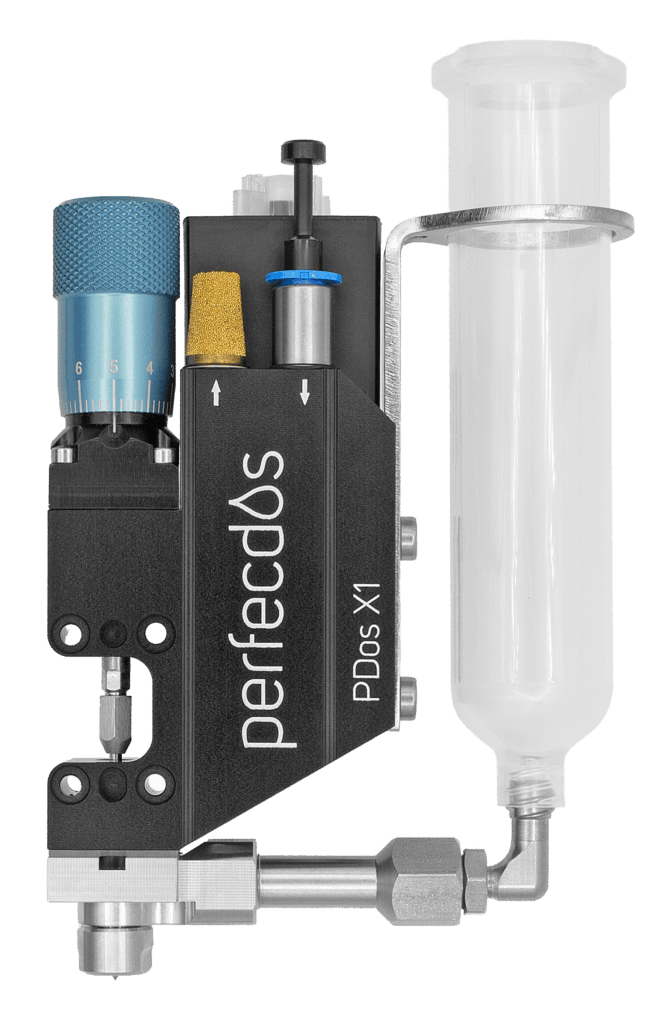
The Piezoelectric actuator is what makes these systems expensive to maintain. They only move a few micrometers, so they use mechanical amplifiers to increase their stroke enough to jet the material. Consequently, these systems have a lot of tiny parts and small-diameter fluid paths. By contrast, the perfecdos PDos X1 head is electro-pneumatically driven with sufficient stroke to jet the material directly. There is no need for the additional components to magnify their stroke. This article explains why these two actuators have vastly different costs of ownership.
Consumable Parts
The seal that separates the jet valve from the fluidic part is a wear-part on both technologies. Piezoelectric systems use proprietary custom-designed seals normally made of exotic materials that can cost $100 each. Second, they can have long lead times so customers are encouraged to keep enough spares in stock to cover this lead time.
By comparison, the perfecdos system uses two standard O-rings. In most cases, NBR is a suitable material, so they only cost a few cents. In rare instances, exotic materials might be required, but an O-ring is still a standard industrial part, so the cost is relatively low. Moreover, they are readily available, so customers do not need a large stockpile.
Spare – Non-Consumable – Parts
The Piezoelectric jet valves require a lot of tiny parts that must be disassembled for maintenance and cleaning. These parts are not intended to be consumable, but they bend or break easily and are easily lost during cleaning and maintenance. In addition to needing frequent replacement, these parts are expensive.
Whereas the perfecdos uses a robust electro-pneumatic actuator. The tappet is 2mm in diameter, so it will not break or bend, so the two O-rings mentioned above are the only replacement parts.
Preventative Maintenance and Cleaning
The complexity of Piezoelectric systems requires highly skilled technicians with extensive training and expensive tools. The small fluid pathways clog easily, so they must be cleaned more frequently, and the head must be disassembled to clean. The small parts are difficult to grip and must be handled with care. Cleaning requires 30-45 minutes per valve, and many systems have multiple valves so downtime can last hours.
Conversely, the perfecdos head has large fluid channels that do not clog as often, and the mechanism is simplified. When cleaning is required, it has fewer parts that are not fragile, so the head can be serviced using standard tools in about 5 minutes.
Unplanned Maintenance
All Piezoelectric jet valves are designed such that material migrates from the wetted area to the actuator when the gasket between them loses its seal. This is a common failure if the unit is not maintained frequently. At a minimum, this failure requires an unplanned cleanup. In the case of adhesives, the unit is normally destroyed.
The perfecdos valve is designed such that the actuator will not break or fill with material if you do not maintain the O-ring on time. Instead, the material will escape from a special drainage outlet. Just change the two O-rings and resume production.
Adjustment
With droplet diameters down to 200 µm and a precision of 99%, jet valves must be readjusted to perform exactly as they did before maintenance. Before Piezoelectric units can be adjusted, they must be calibrated using complicated electronics. Not only is this time-consuming for Piezoelectric, but miscalibration can also cause a failure.
The perfecdos shot size is adjusted using a simple micrometer knob. Simply set the dial correctly, and the system is accurate and repeatable. In the case of multiple valves, they all perform the same.
Safety
Piezoelectric units require at least 120V. Additional safety measures must be employed in rough or wet production areas.
The perfecdos system is low voltage (24v), so no additional safety measures are required.
Redundant Systems
As mentioned above, maintaining and cleaning Piezoelectric systems is time-consuming, and components and trained technicians are not always available. Also, entire units can be destroyed with leaking adhesives or miscalibration. Therefore, companies often purchase duplicate systems to avoid excessive downtime. Duplicate systems are rarely calculated as part of the initial capital investment.
The perfecdos system requires routine maintenance less frequently, and it is fast. Furthermore, improper maintenance will not destroy a unit. There is no need to keep redundant units on standby.
Change in material or end a production
The life cycles of certain product groups are relatively short, and materials can change within a product’s life. Piezoelectric systems are relatively inflexible. They are selected and designed for a specific application. For different viscosities, you need different actuators. This greatly reduces the chance they can be repurposed for another product or accommodate material changes within the current product life, so the TCO can only be amortized over relatively short periods.
The perfecdos system only has one head. It is adjustable and optional components allow it to produce different dot sizes to accommodate many materials a Piezoelectric cannot. This greatly increases the likelihood that engineers can change the material within the same product life cycle and repurpose it when the product life cycle has ended.

In conclusion
The electro-pneumatic plunger in the perfecdos system is much simpler and more robust than the piezoelectric system. It requires less frequent maintenance, less training, and fewer and less expensive consumables.
It is easier and safer to set up and align. In many cases, the reduced cost of ownership is enough to justify replacing existing Piezoelectric units.