
Yield loss in electronics assembly often traces back to inconsistent fluid deposition at the smallest scales. Liquid dispensing systems that automate this step remove the variability that manual application introduces across high-volume production runs.
Modern assembly lines demand deposit accuracy measured in nanoliters, with placement tolerances tighter than a human hand can hold. Automated platforms meet these thresholds while maintaining throughput, giving manufacturers a direct path to higher first-pass yield and lower rework rates.
What Is a Liquid Dispensing System in Electronics Assembly?
A liquid dispensing system applies controlled volumes of fluid materials, such as adhesives, solder paste, conformal coatings, or encapsulants, onto electronic substrates during assembly. Automation governs the volume, position, and timing of each deposit through programmed motion and metered fluid delivery. The result is repeatable placement across thousands of units without operator intervention.
How Automated Dispensing Reduces Defect Rates in PCB Assembly
Defect rates in printed circuit board assembly climb quickly when fluid volumes drift outside spec. Manual application introduces variability from operator fatigue, inconsistent hand pressure, and visual misjudgment across a shift.
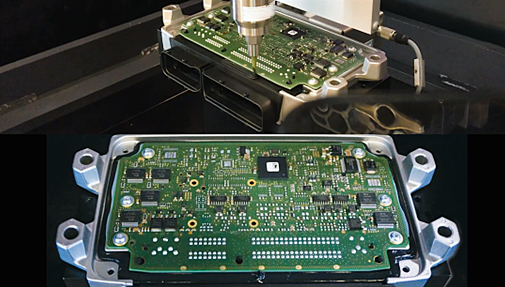
Automated liquid dispensing systems remove these variables by executing every deposit against a programmed volume and coordinate. As a result, the failure modes tied to human application collapse into a much narrower band.
Solder paste misprints, adhesive voids, and coating gaps rank among the most common yield killers on PCB lines. Each defect traces back to either too much fluid, too little, or fluid placed slightly off-target. Consequently, an automated platform holding volume tolerance within a few percent and placement accuracy within microns shrinks these failure modes dramatically. Downstream inspection stations flag fewer units, and rework queues shorten across the board.
Repeatability compounds across production volume, which is where the return on automation becomes clear. Yield gains of two to five percentage points translate into meaningful cost recovery when scaled across annual output. For manufacturers pursuing Six Sigma targets, automated fluid deposition operates as a foundational process control step rather than an optional upgrade.
Key Fluid Types Handled by Liquid Dispensing Systems
Electronics assembly relies on a wide range of liquid dispensing fluid systems, each with distinct rheological behavior. Viscosities span several orders of magnitude, from water-thin solvents to thick, thixotropic pastes. They also come in single- and multi-component forms. Pump technology, nozzle geometry, and pressure profile all adjust to the material at hand.
High-Viscosity Materials
Solder pastes and thermal interface materials sit at the high-viscosity end of the spectrum. These fluids demand positive-displacement pumping to maintain volumetric accuracy shot after shot. Without that control, thick materials starve or overfill deposits as line pressure fluctuates.
Mid-Range Adhesives and Resins
Cyanoacrylate adhesives, UV-cure resins, and silver-filled conductive adhesives fall into the mid-range viscosity band. Contamination control and shot-to-shot repeatability matter as much as raw volume accuracy for these materials. Purpose-built fluid paths keep reactive chemistries stable between deposits, which protects both the bond quality and the equipment.
Low-Viscosity and Specialty Fluids
Conformal coatings and low-viscosity fluxes require careful bead control to prevent runoff on densely populated boards. Meanwhile, abrasive-filled fluids wear standard wetted parts quickly. Liquid dispensing systems address these cases with dedicated fluid paths, hardened components, or contactless jetting that eliminates nozzle wear entirely.
Two-Part Materials in Liquid Dispensing Systems
Two-part epoxies span the full viscosity range used in electronics assembly, from thin underfills to thick structural bonds. Each formulation pairs a resin and hardener that must combine in an exact ratio before the material leaves the nozzle. Epoxy dispensing systems handle this mixing step inline, immediately before each deposit reaches the substrate.
Ratio accuracy at this stage determines cure strength, bond integrity, and long-term reliability under thermal cycling. Static mix tubes handle the mixing task when pot life runs long and shot sizes stay large. The chemistry stays workable long enough to pass through the tube without curing prematurely inside the fluid path.
As a result, static mixing keeps hardware simple and consumable costs low for these formulations. Meanwhile, dynamic mixing chambers become necessary once pot life shortens or shot size drops below a threshold. A short pot life leaves little margin before the resin and hardener begin curing inside a static tube.
Consequently, dynamic chambers actively agitate the mixture at the point of dispense, preventing the material from potting the system. Choosing between the two approaches comes down to matching mixing hardware to the chemistry and the production volume at hand. Therefore, manufacturers running high-mix two-part processes benefit from evaluating both options against pot life and shot size requirements together.
Precision Control Features That Drive Yield Improvements
Precision in fluid deposition rests on a stack of control features working in coordination. Each element governs a different source of variability, and together they define the deposit envelope a system can hold across a production run. The features below appear on advanced liquid dispensing systems built for electronics assembly.
- Closed-loop volumetric metering – Pumps measure and dispense exact fluid volumes on each shot, correcting for viscosity shifts and pressure changes in real time to hold nanoliter-level accuracy.
- Programmable motion control – Multi-axis stages position the nozzle or substrate with micron-level repeatability, following complex paths and dot patterns without operator intervention.
- Vision-guided alignment – Integrated cameras locate fiducials and adjust dispensing coordinates before each deposit, compensating for board-to-board placement variation on the conveyor.
- Temperature and pressure stabilization – Heated fluid paths and regulated air supplies keep material properties constant, preventing viscosity drift from shifting shot volume across long runs.
- Real-time process monitoring – Sensors track dispense weight, pressure signatures, and cycle timing, flagging out-of-spec deposits before they reach the next station.
Together, these features convert dispensing from a variable process into a predictable one. Yield improvements follow directly from the reduction in deposit variance, which explains why manufacturers targeting tight defect budgets prioritize systems with the full control stack.
Selecting Liquid Dispensing Systems for High-Volume Production
High-volume production imposes selection criteria that differ sharply from prototype or low-mix environments. Cycle time, uptime, and consumables cost move to the front of the evaluation for liquid dispensing systems, ahead of raw precision figures. A system that hits tolerance targets but requires frequent nozzle changes or purge cycles will bottleneck a fast-moving line before its accuracy ever pays off.

For that reason, throughput math starts with beats per minute and factors in every non-dispensing action. Fluid refill intervals, nozzle cleaning routines, and program changeover time all subtract from productive capacity.
Systems designed for volume production minimize these interruptions through large reservoirs, self-cleaning cycles, and quick-change tooling. Uptime figures above 95 percent are achievable on well-specified platforms, though the specification work matters as much as the hardware itself.
Total cost of ownership extends beyond the capital purchase into every consumable and every hour of integration engineering. Fluid waste, wetted-part replacement, and downstream integration all contribute to the operating cost per deposit.
Contactless jetting technologies reduce consumable wear and eliminate nozzle contact damage, while volumetric pumps deliver the material efficiency that keeps expensive fluids out of the waste stream. Matching the technology to the fluid, the volume, and the tolerance target produces the strongest yield outcome per dollar invested.
Ready to Improve Yield With Precision Dispensing?
Yield improvement in electronics assembly starts with dispensing processes that hold their tolerances across every shift and every shipment. Liquid dispensing systems built for production environments deliver the repeatability, throughput, and material flexibility that modern PCB lines require. The right platform pays back its investment through defect reduction, rework avoidance, and consistent first-pass yield.
MTA Robotics designs and integrates automated liquid dispensing systems tailored to electronics assembly applications. Reach out to our engineering team to discuss how a purpose-built dispensing solution can lift yield on your assembly line.